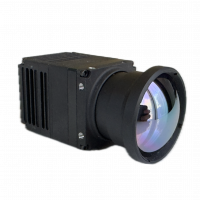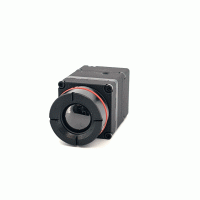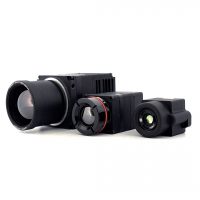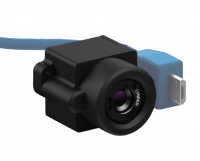
LWIR Thermal Cameras & Cores
What is LWIR?
- Discover the power of LWIR cameras or ‘thermal camera modules’—advanced imaging solutions that operate in the long-wave infrared spectrum, typically spanning 8 to 14 micrometers (μm).
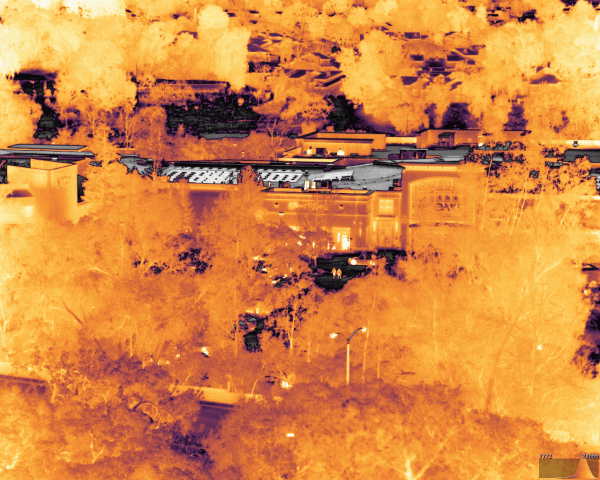
- Unlike visible-light or shortwave infrared (SWIR) systems, LWIR cameras detect thermal radiation emitted by objects and living beings, making them invaluable for seeing in complete darkness, through smoke, or in adverse weather conditions like fog and dust. This unique capability stems from the physics of thermal emission: all objects above absolute zero (-273°C) emit infrared energy proportional to their temperature, which LWIR sensors capture without requiring external illumination.
What are the applications for LWIR cameras?
- LWIR cameras shine across a diverse range of applications, delivering unmatched versatility and reliability. In industrial settings, they enable predictive maintenance by detecting heat leaks, electrical faults, or mechanical wear in machinery before costly failures occur.
- For firefighting and search-and-rescue operations, LWIR cameras cut through smoke and haze to locate hotspots or missing persons with precision.
- In the defense and security sectors, they enhance situational awareness by identifying threats or monitoring perimeters day or night, regardless of lighting conditions.
- Meanwhile, in wildlife conservation and agriculture, LWIR thermal cameras modules track animal movements or assess crop health by mapping temperature variations—capabilities that redefine efficiency and effectiveness across industries.
- For unmanned aerial vehicles (UAVs), our LWIR cameras with small camera cores are game-changers, combining powerful thermal imaging with compact, lightweight designs tailored for aerial platforms. These miniature cores—often weighing less than 100 grams and measuring just a few centimeters—pack high-performance sensors into a form factor ideal for drones, enabling extended flight times without sacrificing payload capacity.
- Whether conducting infrastructure inspections, monitoring pipelines for leaks, or supporting tactical missions, UAVs equipped with our LWIR camera cores deliver real-time thermal data from hard-to-reach vantage points. Their low power consumption and seamless integration with standard UAV interfaces (like UART or USB) ensure operational flexibility, while rugged construction withstands the rigors of flight. With Axiom Optics’ LWIR camera cores, UAV operators unlock unparalleled aerial intelligence, making every mission more impactful and cost-effective.
Formats available: SXGA (1280 x 1024 px), VGA (640 x 480 px) and QVGA (320 x 240 px)
Interfaces available: USB3, UVC, MIPI CSI-2, CameraLink, HD/3G-SDK
Compare LWIR Thermal Cameras
All SeeCube cores share the same 8 to 14 micron waveband, 12 micron pixel pitch, 60 Hz frame rate, and 35 mK thermal sensitivity. Resolution, physical size, and shutter configuration are what separate them. Full specifications and datasheets are available on each product page.
| Model | Resolution | Array size | Operating modes | Best suited for |
|---|---|---|---|---|
| Niels 12 | SXGA 1280 x 1024, 1.3 MP | 15.4 x 12.3 mm | Shuttered, shutterless, radiometric | Maximum detail and longest range at a given lens, 60 Hz at full frame |
| Ernest 6 | VGA 640 x 480 | 7.7 x 5.8 mm | Shuttered, shutterless, radiometric | The balanced choice, 21 x 21 mm and under 20 g, with five USB connector options and UVC plug and play |
| Eileen 3 | QVGA 320 x 240 | 3.8 x 2.9 mm | Shutterless, radiometric | Smallest and lowest cost option where the target is close or large |
| SeeCube family | All three formats | – | Shuttered, shutterless, radiometric | Family overview covering shared architecture, SDK, and accessories |
Because pixel pitch is identical across the family, moving up in resolution widens the field of view at a given lens rather than magnifying the scene. A Niels 12 sees roughly four times the area of an Ernest 6 through the same optic at the same detail per pixel, so the choice is about how much scene must be covered at once, not about image sharpness.
Need calibrated thermography rather than an integration core? See the industrial thermographic cameras. Imaging hot targets, gases, or requiring higher sensitivity than uncooled sensors provide? See the cooled MWIR cameras.
LWIR Thermal Camera FAQs
What is the difference between LWIR, MWIR, and SWIR imaging?
LWIR cameras between 8 and 14 microns detect thermal radiation that objects emit because of their own temperature, so they see in complete darkness with no illumination at all. MWIR cameras from 1 to 5 microns also detect emitted heat, with higher sensitivity to hot targets and access to gas absorption features, but they require cryogenic cooling. SWIR cameras image reflected light rather than heat, producing images that look like sharp black and white photographs and revealing moisture, plastics, and features hidden beneath surfaces.
Do LWIR thermal cameras need cooling?
No. These cores use uncooled microbolometer sensors that operate at ambient temperature, which is what makes them small, low power, and quick to start imaging. Cooled detectors offer higher sensitivity and much faster frame rates, but they add a cryocooler along with its size, power draw, cost, and finite service life. For most thermal imaging tasks, uncooled performance is more than sufficient.
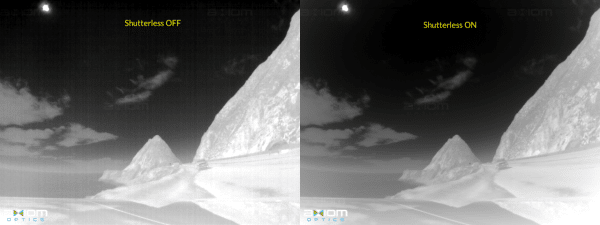
What is the difference between shuttered and shutterless operation?
As an uncooled sensor warms, the uniformity of its response drifts and needs correcting. Shuttered cameras handle this by closing an internal mechanical shutter and performing a flat field correction against it, which briefly interrupts the image. Shutterless cameras are factory calibrated across a range of sensor temperatures so image quality holds without that interruption, which matters for continuous surveillance, tracking, and recording where a dropped frame is unacceptable.
What does NETD mean and why does 35 mK matter?
NETD, or noise equivalent temperature difference, is the smallest temperature difference the camera can distinguish from its own noise. A lower number means finer thermal detail. At 35 mK these cores resolve differences of a few hundredths of a degree, which is what makes subtle features visible: heat loss through a wall, a slightly warm electrical connection, or a temperature gradient across a machine component.
What is the difference between a radiometric and a non-radiometric thermal camera?
A non-radiometric camera produces a thermal image where relative differences are visible but pixel values do not correspond to actual temperatures. A radiometric camera is calibrated against a black body so every pixel reports a real temperature value, in this family across roughly -10°C to +120°C with typical accuracy of ±2°C or 2 percent. Radiometry is required whenever a measurement, threshold, or alarm depends on an absolute number rather than a visual comparison.
Can thermal cameras see through walls or glass?
No to both. Thermal cameras detect radiation emitted from surfaces, so a wall shows the wall’s own surface temperature, which can reveal insulation gaps, pipes, or wiring behind it through the heat they conduct to the surface, but not the objects themselves. Glass is opaque in the LWIR band and reflects like a mirror, so a thermal camera sees the glass surface and reflections rather than what lies behind it. LWIR does penetrate smoke, haze, dust, and light fog far better than visible light, which is where its real seeing-through advantage lies.
Are these thermal cameras suitable for drones?
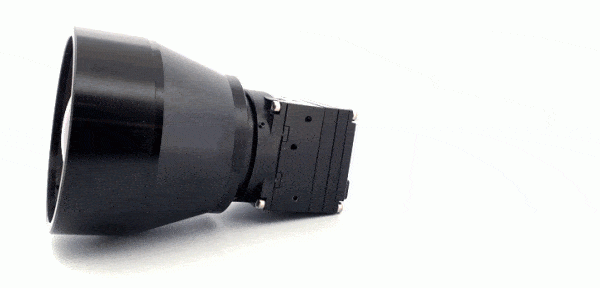
Yes. Low size, weight, and power are the defining characteristic of this family: the Ernest 6 occupies a 21 x 21 mm cross section, weighs under 20 g without a lens, and draws under 400 mW directly from the USB bus with no external power supply. That combination suits UAV payloads, handheld instruments, and embedded OEM designs, and the UVC interface means it integrates with common onboard computers such as NVIDIA Jetson and Raspberry Pi without custom drivers.
How quickly can an LWIR core be integrated into a system?
Faster than most machine vision cameras. Because the cores present themselves over USB using the UVC protocol, the host recognizes them as a standard video device and the first thermal frame typically arrives within minutes of plugging in. From there, a free C++ SDK with an OpenCV sample application provides shutter control, correction modes, palette and mapping options, and image and video capture on Windows, Linux x64, and Linux for ARM.