
High-Speed Scientific Cameras
High-speed scientific cameras capture fast events that standard cameras blur or miss entirely: calcium and voltage transients, flowing particles, combustion, plasma dynamics, and nanosecond fluorescence decays. Axiom Optics offers high-speed cameras across every major sensor technology, from back-illuminated sCMOS and quantitative CMOS (qCMOS) to global shutter CMOS, intensified CMOS (ICMOS), and gated SPAD arrays, with full-frame rates from about 100 fps to several thousand fps and region-of-interest rates beyond 100,000 fps.
Compare High-Speed Scientific Cameras
The table below summarizes every high-speed camera in this category. Speeds are full-frame rates in each camera’s fastest standard mode, with the fastest published region-of-interest (ROI) rate in parentheses. Full specifications, readout modes, and datasheets are on each product page.
| Model | Sensor | Resolution and pixel | Full frame (fastest ROI) | Best suited for |
|---|---|---|---|---|
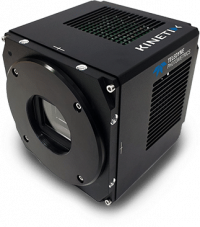
| Kinetix & Kinetix22 | Back-illuminated sCMOS | 3200 x 3200 or 2400 x 2400, 6.5 µm | 498 or 664 fps (107,200 fps) | Fast low-light imaging over a large field: light sheet, voltage and calcium imaging, single-molecule work |
| ORCA-Fire | Back-illuminated sCMOS | 4432 x 2368, 4.6 µm | 115 fps (19,500 fps) | High-throughput, low-magnification and light-sheet imaging with 1.0 e- rms read noise |
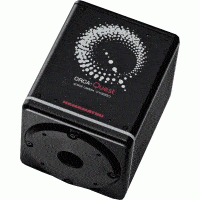
| ORCA-Quest 2 | Back-illuminated qCMOS, photon-number resolving | 4096 x 2304, 4.6 µm | 120 fps (19,800 fps) | Quantum imaging, qubit readout, and photon counting at 0.25 e- median read noise |
| CB2 | Global shutter CMOS | 816 x 624 to 5328 x 4608, 2.74 to 9 µm | Up to 1,594 fps (7,366 fps) | Adaptive optics wavefront sensing, quantum computing, microfluidics, and astronomy |
| CB2 UV | Back-illuminated global shutter CMOS, UV optimized | 2848 x 2848, 2.74 µm | 194 fps (2,002 fps) | Fast UV imaging from 200 to 400 nm: semiconductor inspection, combustion, plasma |
| HiCAM Fluo | Cooled intensified CMOS, 10 ns gating | 1280 x 1024 at 6.6 µm or 1920 x 1080 at 10 µm | 1,000 or 2,000 fps (7,500 fps) | High-speed fluorescence and luminescence down to single photons, combustion, microfluidics |
| TRiCAM | Time-resolved intensified CMOS, global shutter | 1920 x 1200, 5.86 µm | 162 fps | Widefield FLIM, FRET, and time-gated luminescence with gates below 3 ns |
| SPAD512 & SPAD Alpha | Gated SPAD array, global shutter, zero read noise | 512 x 512 at 16.38 µm or 1024 x 1024 at 16 µm | Up to 100,000 fps at 1-bit | Photon counting, widefield FLIM with 6 ns gates, quantum correlation and light-in-flight imaging |
| EoSens | Global shutter CMOS, CoaXPress | 1.1 to 21 MP, 4.5 to 13.7 µm | 230 to 3,674 fps (225,000 fps) | Industrial motion analysis, laser triangulation, inspection, and fluid dynamics |
Need the lowest noise rather than the highest speed? See the photon counting cameras, or browse intensified imaging and SPAD cameras and arrays for time-resolved work.
How to Choose a High-Speed Scientific Camera
The right high-speed camera depends on how fast the event is, how many photons reach the sensor in each frame, and how much of the field must be captured at that speed. These are the specifications that separate the cameras above.
Full-frame speed vs. region-of-interest speed
Most CMOS sensors read out row by row, so reading fewer rows raises the frame rate almost proportionally. Published maximum frame rates are often quoted for a strip only a few rows tall, which is useful for line scans, kymographs, and spectroscopy but not for imaging a full field. Compare full-frame rates when the whole field matters, and ROI rates when the event can be confined to a band of the sensor.
Global shutter vs. rolling shutter
A global shutter exposes every pixel at the same instant, which freezes fast motion without distortion and makes pulsed illumination simple to synchronize. The CB2, EoSens, TRiCAM, and SPAD cameras use global shutters. Rolling-shutter sCMOS cameras such as the Kinetix and ORCA family expose row by row with lower read noise, and offer effective global shutter or light-sheet readout modes for synchronized illumination.
Sensitivity at speed
Every increase in frame rate shortens the exposure, so each frame collects fewer photons. At high speed, read noise and quantum efficiency decide whether a dim signal is visible at all. Back-illuminated sCMOS cameras pair QE above 80 percent with read noise near 1 electron; qCMOS cameras such as the ORCA-Quest 2 reach well below 0.5 electrons and can resolve individual photoelectrons.
Nanosecond gating and time-resolved imaging
When the event itself lasts nanoseconds, frame rate is no longer the limit; gate width is. Intensified cameras like the HiCAM Fluo and TRiCAM, and gated SPAD cameras like the SPAD512, can open the exposure for only a few nanoseconds and step that window in picoseconds, enabling fluorescence lifetime imaging (FLIM), time-gated luminescence, and imaging through a bright, prompt background.
Bit depth, data rate, and interface
Data rate grows with pixel count, frame rate, and bit depth together: a 10 megapixel sensor at 500 fps produces more than 5 gigapixels per second. Many cameras offer an 8-bit speed mode that trades dynamic range for frame rate. Sustaining full speed usually requires CoaXPress or PCIe, while USB 3 suits lower frame rates and simpler integration. Plan the frame grabber, storage, and acquisition PC alongside the camera.
Field of view and pixel size
Large sensors cover more of the sample per frame, which raises throughput in light-sheet, high-content, and flow imaging. Pixel size sets how finely the image is sampled and how much light each pixel gathers: small pixels resolve detail through low-magnification optics, while large pixels collect more photons per pixel for low-light work at high magnification.
Spectral range
Standard back-illuminated sensors cover the visible and near infrared. For deep UV work from 200 to 400 nm, the CB2 UV is optimized for ultraviolet transmission and response, and intensified cameras can be specified with photocathodes matched to the wavelength range of the experiment.
For a broader overview of camera technologies, read the scientific camera buyers guide, or contact Axiom Optics to discuss the speed, sensitivity, and field of view your application needs.
High-Speed Scientific Camera FAQs
What frame rate counts as a high-speed scientific camera?
Standard scientific cameras typically run at 30 to 100 fps at full resolution. High-speed scientific cameras reach several hundred to several thousand fps at full frame, and far higher rates on a reduced region of interest. Gated SPAD cameras reach 100,000 fps in 1-bit photon counting mode.
Do I need a global shutter camera for high-speed imaging?
A global shutter is the best choice for fast-moving objects, pulsed or strobed illumination, and machine vision measurements, because every pixel is exposed simultaneously. For fluorescence microscopy where the lowest read noise matters, a rolling-shutter sCMOS with an effective global shutter mode is often the more sensitive option.
Which camera is best for fluorescence lifetime imaging (FLIM)?
Widefield FLIM needs nanosecond gating or modulation rather than raw frame rate. The TRiCAM supports gates below 3 ns and frequency-domain modulation, while the SPAD512 and SPAD Alpha combine 6 ns gates, 17 ps gate steps, and zero read noise for photon-counting FLIM.
Which high-speed camera is most sensitive in low light?
For low light at speed, choose a back-illuminated sensor with very low read noise. Among the CMOS cameras here, the ORCA-Quest 2 has the lowest read noise and photon-number resolving output, the Kinetix combines sub-electron and high-speed modes, and intensified or SPAD cameras detect single photons at nanosecond timescales.
Why is my camera slower than its maximum frame rate?
Maximum frame rates assume a specific readout mode, bit depth, ROI, and interface. Full-frame operation, 16-bit modes, long exposure times, and USB connections all reduce the achievable rate. Check the full-frame rate for your mode and interface on the product datasheet.
Can a high-speed scientific camera replace an EMCCD?
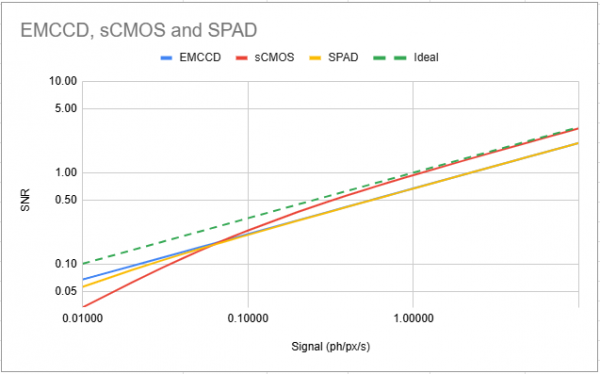
For most applications, yes. Back-illuminated sCMOS and qCMOS cameras now match or exceed EMCCD sensitivity above a few photons per pixel while running faster over larger fields. EMCCDs keep an edge mainly at true single-photon signal levels.



View our Camera Catalog
 Click to view
Blogs

Scientific Camera Buyers Guide
Imaging with very few photons: EMCCD, sCMOS, and SPAD Detectors
Videos


 C-BLUE One / Focus on WFS & AO